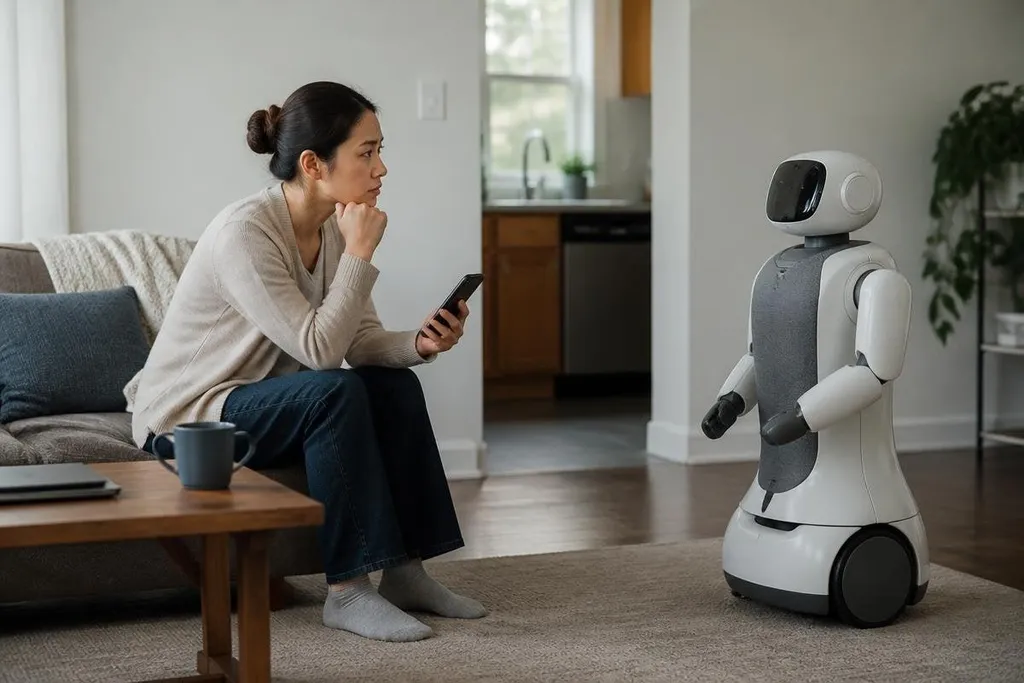
A companion robot has to do more than speak, move, or answer a request. It has to work safely in a home, protect private data, and remain useful after the first week.
With no product evidence supplied for this topic, the fair question is what home companion robots must prove before anyone buys one.
- Useful work: Can it help with a task you repeat every day?
- Safe behavior: Can it stop when a person, pet, or object enters its path?
- Private operation: Can you control what it records and where that data goes?
Conversation is the easy part
Speech gives a companion robot a familiar interface, but a voice reply does not show that the robot understands the room. A useful system needs to connect a request with an action, check whether the action worked, and ask for help when it cannot tell.
That chain matters for small tasks. “Bring me the charger” could mean finding a known object, moving around furniture, picking it up, and carrying it without dropping it. Each step can fail for a different reason, so a smooth conversation can hide weak physical performance.
The robot also needs a clear limit. If it cannot identify an object, reach a shelf, or move across a loose rug, it should say so. A short refusal is safer than a confident action based on a wrong guess.
The home is a hard place to work
Factories give robots marked paths, fixed tools, and controlled lighting. Homes change from room to room. Chairs move, pets cross the floor, children leave objects in walkways, and sunlight can alter what a camera sees.
That makes movement and handling more important than a polished demo. Tests should show how the robot reacts to blocked paths, low light, dropped objects, and a person who steps in front of it. A video that shows only a clean task says little about daily use.
Safety also includes the robot’s body. Motors, joints, wheels, and grippers need limits that keep contact gentle. The stop control must be easy to reach, and the robot should make its state clear when it is moving, listening, charging, or waiting for a person.
Privacy has to be a physical setting
A robot with microphones and cameras can collect details from inside the home. The buyer needs clear controls for recording, storage, deletion, and remote access. Those controls should be visible on the robot or in its software, not buried in a long account setup.
A useful test is to ask what happens when the internet connection fails. The robot may lose remote services, but basic safety should remain local. If a network outage stops the robot from braking or accepting a stop command, the design is not ready for a living space.
Claims about companion robots need a record of the machine, test date, task, and result. Dated companion robot reporting can give you that record before the next section asks who pays for the robot and how that changes the risk.
The business model changes the risk
The purchase price is only one part of the cost. A companion robot may need a service plan, replacement parts, cloud storage, software updates, or a trained installer. Those terms affect whether the robot stays useful after its first year.
Support matters when a robot is part of a care routine. If a sensor fails, the owner needs to know the repair path, expected wait, and price. A system that depends on a remote service also needs a clear plan for shutdowns and account cancellation.
The unproven point is long-term usefulness. A robot can complete a short demo and still offer too little help for its cost. I'd wait for evidence from ordinary homes before treating a companion robot as a household purchase.
A buyer’s check before purchase
Use this list when a product reaches the market. Ask for a recorded answer to each point.
- Task record: Which named tasks has the robot completed without a remote operator?
- Failure behavior: What does it do when an object is missing or its path is blocked?
- Safety control: Can a person stop motion from the body, without an app or network?
- Data control: Can you turn off each sensor, delete stored data, and remove remote access?
- Service terms: What do updates, repairs, parts, and account closure cost?
- Home evidence: Were tests run in ordinary rooms with people, pets, and moved furniture?
A home companion robot will earn a place at home through repeatable task results, clear safety limits, and plain service terms. Until makers publish those details, treat the category as a set of claims waiting for evidence.